Chốt mẫu vật liệu trước khi sản xuất nội thất không phải việc “xem ảnh catalogue rồi gật đầu”. Cùng một mã màu, tấm thật có thể khác ánh sáng phòng, khác vân đá, khác cạnh dán, hoặc khác lô sản xuất. Nếu chỉ chốt trên màn hình, hai bên dễ tranh luận khi hàng đã cắt.
Checklist thực hành do Square biên soạn cho dự án thiết kế – thi công nội thất căn hộ hoặc nhà phố. Không phải biểu mẫu hợp đồng hay tư vấn pháp lý; kết luận cuối phải khớp hồ sơ đã duyệt và thỏa thuận các bên. Bài này nói về chốt mẫu và mock-up trước sản xuất — khác đo đạc hiện trạng căn hộ trước thiết kế và khác cách tách dòng trên kiểm báo giá từng dòng trước khi ký, nhưng phải khớp cùng họ phiên bản. Vai trò ai chốt mẫu nên khớp ma trận RACI dự án nội thất. Loại ván theo việc đã viết ở chọn ván MDF, MFC và plywood theo phòng, không lặp lại ở đây.
Ảnh catalogue không thay mẫu thật
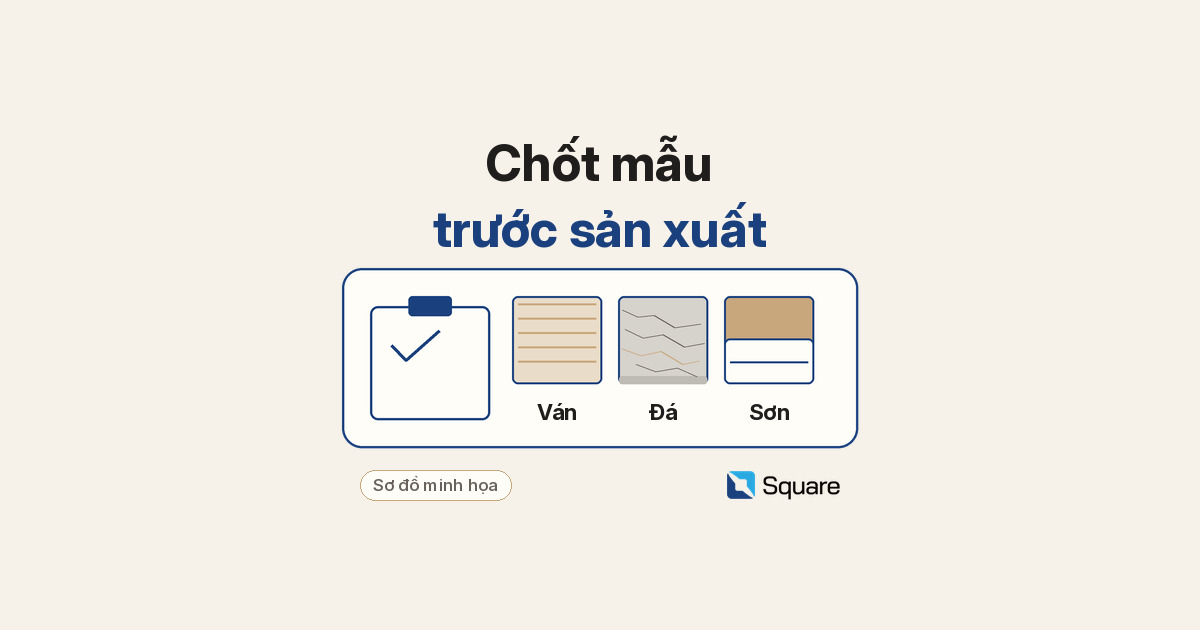
Ảnh catalogue và tấm render thường được chỉnh sáng, cắt vân và ghép ở điều kiện studio. Mẫu thật — tấm ván, cánh sơn, đá, sàn, tay nắm, vải — cho thấy màu, vân, cạnh và tay cảm. Với đá và gỗ có vân, hãy xem đúng tấm hoặc đúng hướng vân sẽ dùng, không chỉ xem một miếng nhỏ trên catalogue.
Đừng chốt “cùng màu với ảnh” nếu chưa cầm mẫu. Hai mã trông giống nhau trên màn hình có thể khác nhau khi đặt cạnh nhau dưới ánh sáng thật.
Xem mẫu đúng ánh sáng và đúng vị trí
Mang mẫu vào đúng phòng, xem lúc ngày và lúc có đèn (đèn đã dự kiến, hoặc đèn tạm cùng họ ánh sáng nếu hệ đèn chưa lắp). Sơn, đá và ván có thể trông khác nhau giữa ánh sáng cửa sổ và ánh sáng đèn. Đừng chốt vội dưới đèn showroom rồi bất ngờ khi về căn hộ.
Nếu hệ đèn chưa chốt, ghi rõ mẫu đang được xem dưới điều kiện nào, để lần xem lại dùng cùng điều kiện. Cách ghi mã đèn nằm ở bài chọn chiếu sáng căn hộ theo phòng; ở đây chỉ cần điều kiện xem mẫu được ghi vào hồ sơ.
Mock-up những chỗ dễ hối
Với hạng mục lớn hoặc khó đổi: một cánh tủ hoàn thiện (màu, cạnh, tay nắm), một đoạn mạch sàn, một góc đá gần mép và lỗ vòi nếu có. Mock-up không cần cả căn, nhưng phải đủ để hai bên nhìn đúng việc thật. Cạnh dán, mạch ghép và hướng vân thường không thấy hết trên mẫu nhỏ.
Chi tiết khu ướt không thay bằng một tấm mẫu khô trong văn phòng — dẫn về hệ cốt–cạnh–bề mặt ở vật liệu chống ẩm cho bếp và WC.
Ghi mã, lô, ngày và người xác nhận
Mỗi mẫu được chọn nên gắn: mã (và cấp nếu có), vị trí dùng, hướng vân nếu cần, ngày xem, điều kiện ánh sáng, và tên người xác nhận vai trò A theo RACI. Ảnh mẫu đã ký nên nằm trong hồ sơ, không chỉ trong tin nhắn. Nếu nhà cung cấp ghi số lô, giữ số đó cùng mã.
Cách tách dòng vật tư trên báo giá đã có ở bài kiểm báo giá; bài này không viết lại. Giữ cùng họ phiên bản giữa mẫu đã ký, bản vẽ, bảng vật liệu và báo giá.
Đổi mẫu sau ngày chốt
Sau ngày chốt, đổi mã, đổi lô hoặc đổi hướng vân phải cập nhật phụ lục, bản vẽ và báo giá trước khi cắt hoặc đặt đá. Đừng chỉ chat “đổi màu này”. Điều khoản phát sinh và mốc chốt nên khớp điều khoản hợp đồng thi công nội thất.
Nếu hàng đã cắt theo mẫu cũ, hai bên phải thống nhất phần nào giữ, phần nào làm lại — bài này không định giá và không nêu thời hạn bảo hành; phạm vi bảo hành xem bảo hành nội thất: phạm vi, thời hạn và việc làm khi có lỗi.
Điều gì dễ nhầm — và checklist một trang
- Chốt chỉ từ ảnh catalogue hoặc render, chưa xem mẫu thật.
- Xem mẫu trong showroom, không xem lại trong phòng thật hoặc dưới ánh sáng đã ghi.
- Không làm mock-up cánh, cạnh, mạch sàn hoặc mép đá ở hạng mục khó đổi.
- Mẫu không có mã, ngày, vị trí và chữ người xác nhận.
- Đổi mã sau chốt mà chưa cập nhật phụ lục trước khi cắt.
Trước khi đặt hàng và cắt cốt, đọc lại năm dòng này trên một trang và khớp với mẫu đã ký.
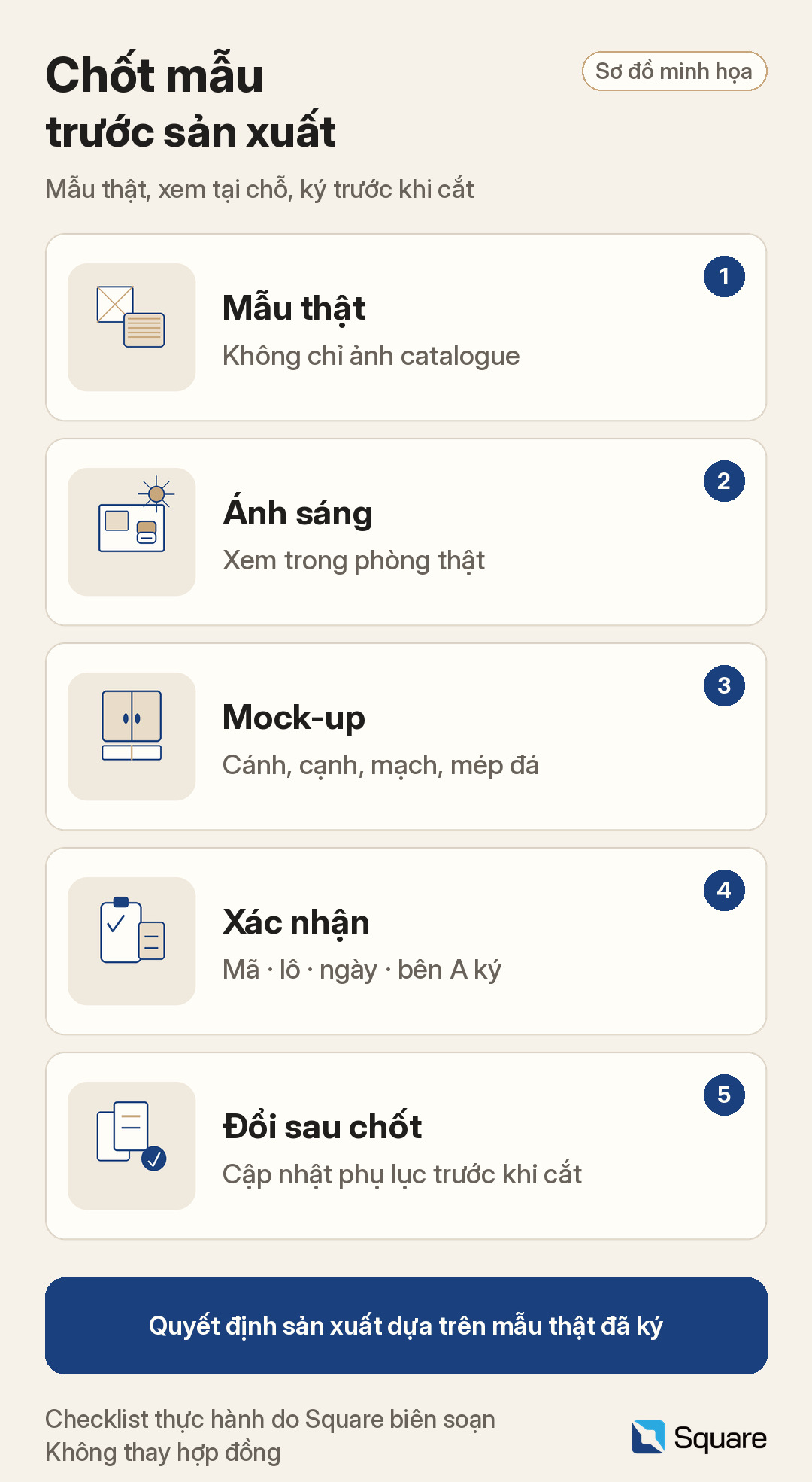
- Quyết định sản xuất dựa trên mẫu thật, không chỉ ảnh catalogue.
- Xem mẫu trong đúng phòng và ghi điều kiện ánh sáng.
- Mock-up cánh, cạnh, mạch hoặc mép đá với hạng mục khó đổi.
- Mỗi mẫu: mã, lô nếu có, vị trí, ngày, người xác nhận (RACI).
- Đổi sau chốt: cập nhật phụ lục, bản vẽ và báo giá trước khi cắt.
Câu hỏi thường gặp
Xem mẫu trên màn hình được không?
Chỉ để sàng lọc. Quyết định sản xuất nên dựa trên mẫu thật đã xác nhận.
Mẫu nhỏ có đủ cho đá và sàn không?
Thường chưa đủ nếu vân, mạch hoặc hướng lát quyết định cảm quan; hỏi một mock-up đoạn thật trước khi đặt cả hạng mục.
Ai được quyền chốt mẫu?
Người vai trò A trên ma trận RACI, không phải mọi người trong nhóm chat. Bài này không nêu mã TCVN cho mẫu.
Cần hỗ trợ chốt mẫu trước khi sản xuất?
Liên hệ Square qua trang Liên hệ để trao đổi thiết kế – thi công nội thất và cách ghi mã mẫu, ngày xem và người xác nhận trên hồ sơ trước khi cắt.
Tham khảo thực hành, không thay hợp đồng, catalogue hãng hoặc tư vấn pháp lý. Không nêu số liệu thống kê, đơn giá hay mã TCVN; áp dụng theo hồ sơ và thỏa thuận các bên.
English version — sentence-aligned with the Vietnamese text above.
Locking material samples before interior production is not a matter of “looking at a catalogue photo and nodding”. Under the same colour code, the real board can differ with room light, stone veining, edge banding, or the production batch. If the lock happens only on a screen, the two parties often argue after the goods have already been cut.
A practice checklist prepared by Square for apartment or townhouse design–build interiors. It is not a contract form or legal advice; the final call must match approved documents and party agreements. This article is about locking samples and mock-ups before production — not measuring an apartment’s existing conditions before design, and not the line-by-line method in checking a quote line by line before signing, though all three must share the same revision family. Who locks the sample should match the interior-project RACI matrix. Board types by job are already in choosing MDF, MFC and plywood by room and are not repeated here.
A catalogue photo does not replace a physical sample
Catalogue photos and renderings are often colour-graded, cropped at the vein, and composited under studio light. A physical sample — a board, a painted door, a stone, a floor plank, a handle, a fabric — shows colour, grain, the edge, and the feel in the hand. For veined stone and wood, view the actual slab or the grain direction that will be used, not only a small catalogue chip.
Do not lock “the same colour as the photo” if you have not held a sample. Two codes that look alike on a screen can differ when placed side by side in real light.
View the sample in the right light and in the right place
Bring the sample into the actual room, and view it in daylight and with the lights on (the planned fixtures, or temporary lights in the same light family if the system is not installed yet). Paint, stone, and boards can look different under window light and under electric light. Do not lock in a hurry under showroom lights and then be surprised in the apartment.
If the lighting system is not locked yet, record the conditions under which the sample is being viewed, so a later viewing uses the same conditions. How fixture codes are written belongs in the article on choosing apartment lighting by room; here, only the viewing condition needs to go into the file.
Mock up the details that are hard to undo
For large or hard-to-change items: one finished cabinet door (colour, edge, handle), a short run of floor joints, a stone corner near an edge and a tap hole if any. The mock-up does not need to be the whole room, but it must be enough for both parties to see the real job. Edge banding, joint lines, and grain direction are often incomplete on a small chip.
Wet-zone details are not replaced by a dry office sample — send readers to the core–edge–face system in moisture-resistant materials for kitchens and WCs.
Write the code, the batch, the date, and who confirms
Each chosen sample should carry: the code (and the grade if any), the location, the grain direction if needed, the viewing date, the lighting conditions, and the name of the A-role confirmer under the RACI. A signed photo of the sample should sit in the file, not only in a chat. If the supplier prints a batch number, keep that number with the code.
How material lines are split on the quote already sits in the quote-checking article; this article does not rewrite that method. Keep the signed sample, the drawings, the material schedule, and the quote in the same revision family.
Changing a sample after the lock date
After the lock date, a change of code, batch, or grain direction must update the appendix, the drawings, and the quote before cutting or ordering stone. Do not only chat “change to this colour”. Variation terms and lock milestones should match the interior construction contract terms.
If goods have already been cut to the old sample, the parties must agree what is kept and what is remade — this article does not set a price and does not state a warranty period; warranty scope is in interior warranty: scope, term, and what to do when a defect appears.
What is easy to mix up — and a one-page checklist
- Locking only from a catalogue photo or a rendering, with no physical sample.
- Viewing the sample in a showroom, and not again in the real room or under the recorded light.
- No mock-up of a door, an edge, a floor joint, or a stone edge on a hard-to-change item.
- A sample with no code, date, location, or confirmer’s mark.
- Changing the code after lock without updating the appendix before cutting.
Before ordering and before the carcass is cut, reread these five lines on one page and match them to the signed sample.
- Base the production decision on a physical sample, not only a catalogue photo.
- View the sample in the actual room and record the lighting conditions.
- Mock up the door, edge, joint, or stone edge on hard-to-change items.
- Each sample: code, batch if any, location, date, confirmer (RACI).
- A change after lock: update the appendix, the drawings, and the quote before cutting.
FAQ
Can a sample be approved on a screen?
Only for shortlisting. The production decision should rest on a confirmed physical sample.
Is a small chip enough for stone and flooring?
Often not, if the vein, the joint, or the laying direction decides the look; ask for a short real-run mock-up before ordering the whole item.
Who is allowed to lock a sample?
The A-role person on the RACI matrix, not everyone in the group chat. This article states no TCVN codes for samples.
Need help locking samples before production?
Contact Square via the Contact page to discuss design–build interiors and how to write the sample code, viewing date, and confirmer on the documents before cutting.
Practice reference only; not a substitute for contracts, brand catalogues, or legal advice. No statistics, unit prices, or TCVN codes are stated; apply per documents and party agreements.