Chống thấm nhà vệ sinh phải ngâm thử nước và nghiệm thu trước khi cán vữa và ốp lát, nên là hạng mục nặng cần làm sớm. Mùng 1 Tết Đinh Mùi là thứ Bảy 6/2/2027, nên chốt thợ cuối tháng 11 và làm khu ướt trong tháng 12/2026. Ghi mực nước, giờ ngâm và người ký vào biên bản.
Phiên bản: v1.3 · Cập nhật: 22/11/2026 · Kiểm chứng mốc Tết: 18/11/2026 · Kiểm chứng nguồn kỹ thuật: 19/11/2026 · Nguồn giá: bài này không nêu đơn giá · Phục vụ: toàn quốc · Đơn vị: CÔNG TY TNHH THIẾT KẾ VÀ CÔNG NGHỆ SQUARE (SQDT) · Người rà soát: SQUARE Editorial
Square.vn là website của CÔNG TY TNHH THIẾT KẾ VÀ CÔNG NGHỆ SQUARE (SQDT), đơn vị thiết kế, kiến trúc, xây dựng và fit-out, phục vụ toàn quốc. Checklist thực hành do Square biên soạn cho chủ nhà có nhà vệ sinh cần sửa hoặc chống thấm lại. Không phải biểu mẫu hợp đồng hay tư vấn kỹ thuật; thông số cuối phải theo chỉ dẫn của hãng vật liệu và hồ sơ đã duyệt. Bài này không nêu giá hay thời lượng thi công bắt buộc; các con số trong bài chỉ là ví dụ từ hướng dẫn trong nước. Bài nối tiếp Sửa nhà trước Tết 2027, và vai trò từng bên nên khớp ma trận RACI dự án nội thất.
Vì sao chống thấm nhà vệ sinh nên làm sớm khi sửa nhà trước Tết?
Sau khi chống thấm, màng cần thời gian khô, rồi phải ngâm thử nước và nghiệm thu thì mới cán vữa bảo vệ và ốp lát. Theo một hướng dẫn thi công trong nước, ngâm thử nước là bước kiểm tra phát hiện lỗi khi sửa còn rẻ, vì sau khi lát gạch mọi sửa chữa đều phải đục.
Thời gian chờ phụ thuộc vật liệu và thời tiết, nên phải theo chỉ dẫn của hãng. Ví dụ, một hướng dẫn cho sản phẩm chống thấm gốc xi măng ghi chờ màng khô tối thiểu 2 ngày rồi ngâm thử tối thiểu 24 giờ; cộng lại, từ lúc quét xong lớp cuối đến lúc cán vữa hay lát gạch mất tối thiểu 3 ngày.
Về tiêu chuẩn, TCVN 5718:1993, ban hành 1993, quy định một số giải pháp kỹ thuật chống thấm nước cho mái và sàn bê tông cốt thép khu dùng nước, như buồng tắm và buồng vệ sinh, trong nhà ở. Bài này không dùng tiêu chuẩn đó để ấn định số giờ ngâm thử; một hướng dẫn nghiệm thu trong nước cũng ghi rõ khoảng 24 đến 72 giờ là thực hành phổ biến chứ không phải điều khoản bắt buộc của một TCVN cụ thể, nên thông số phải ghi trong chỉ dẫn kỹ thuật của dự án.
Nhà vệ sinh nên làm theo thứ tự nào?
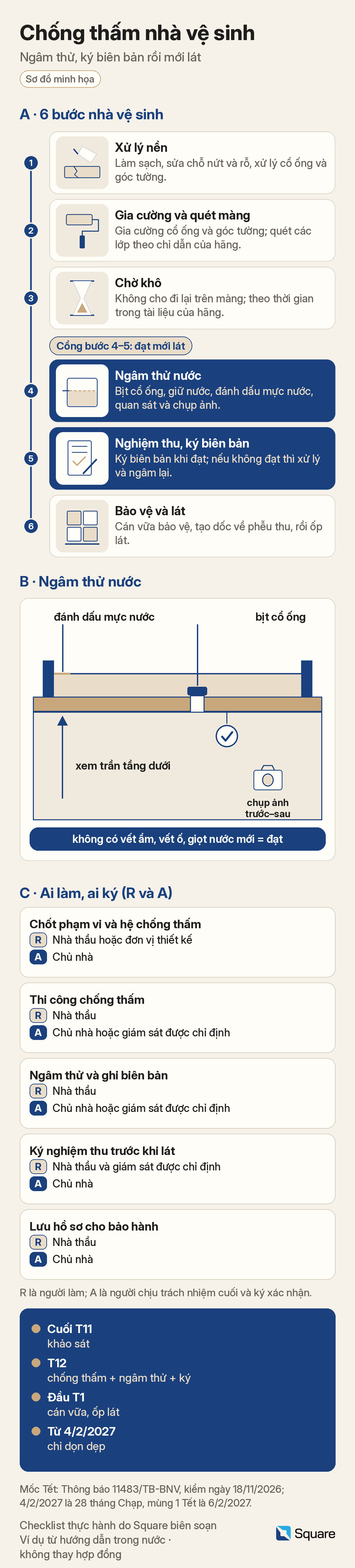
Các hướng dẫn trong nước thường xếp thứ tự như bảng dưới: xử lý nền, gia cường cổ ống và góc tường, quét màng, chờ khô, ngâm thử, nghiệm thu rồi mới bảo vệ và lát gạch. Vật liệu cho tủ và vách khu ướt xem vật liệu chống ẩm cho bếp và nhà vệ sinh.
| Bước | Việc |
|---|---|
| 1. Xử lý nền | Làm sạch, sửa chỗ nứt và rỗ, xử lý cổ ống và góc tường. |
| 2. Gia cường và quét màng | Gia cường cổ ống và góc tường; quét các lớp theo chỉ dẫn của hãng. |
| 3. Chờ khô | Không cho đi lại trên màng; theo thời gian trong tài liệu của hãng. |
| 4. Ngâm thử nước | Bịt cổ ống, giữ nước, đánh dấu mực nước, quan sát và chụp ảnh. |
| 5. Nghiệm thu | Ký biên bản khi đạt; nếu không đạt thì xử lý và ngâm lại. |
| 6. Bảo vệ và lát | Cán vữa bảo vệ, tạo dốc về phễu thu, rồi ốp lát. |
Theo các hướng dẫn thi công trong nước, màng nên được che bằng vữa bảo vệ trước khi lát gạch, và trước khi cán không nên để người đi lại hay vật sắc nhọn làm rách màng. Một số hướng dẫn còn khuyên ngâm thử lần hai khoảng 24 giờ sau khi lát gạch; hãy hỏi nhà thầu có làm bước này không và ghi vào hợp đồng.
Ngâm thử nước làm như thế nào và thế nào là đạt?
Trước khi ngâm, bịt phễu thu và các cổ ống thoát, rồi đắp gờ nhỏ ở cửa để giữ nước. Nhiều hướng dẫn nêu mực nước khoảng 3 đến 5 cm trên sàn đã chống thấm, đánh dấu mực nước ban đầu lên tường và ngâm ít nhất 24 giờ, tốt nhất 48 giờ. Các nguồn nêu mực nước và số giờ khác nhau, nên hãy lấy theo hồ sơ dự án.
Trong lúc ngâm, kiểm tra trần tầng dưới, quanh cổ ống và chân tường phòng bên cạnh, rồi chụp ảnh trước và sau. Để phân biệt bay hơi với rò rỉ, có thể đặt một xô nước bên cạnh, đánh dấu mực nước và so mức hụt của hai nơi.
Đạt là khi không có vết ẩm, vết ố hoặc giọt nước mới ở trần và tường. Nếu có, xả nước, để khô, tìm điểm thấm, xử lý rồi ngâm lại từ đầu; không thi công hoàn thiện khi chưa đạt.
Gợi ý của Square: nếu nhà không có tầng dưới để quan sát, hãy hỏi nhà thầu cách kiểm khác và ghi cách đó vào biên bản.
Biên bản nghiệm thu chống thấm nên ghi gì?
Biên bản một trang là hồ sơ nên giữ khi cần đối chiếu hoặc hỏi về bảo hành. Nên ghi các mục sau.
- Vị trí và diện tích khu đã chống thấm.
- Tên vật liệu, mã hoặc lô, và số lớp đã quét.
- Ngày quét xong lớp cuối, ngày bắt đầu và ngày kết thúc ngâm thử.
- Mực nước ban đầu và cuối, cùng ảnh trước và sau.
- Kết quả đạt hoặc không đạt, và cách xử lý nếu có thấm.
- Tên và chữ ký người làm, người xác nhận.
Cách ghi mã và người xác nhận giống bước chốt mẫu vật liệu trước khi sản xuất; nghiệm thu chung xem nghiệm thu nội thất căn hộ; phạm vi bảo hành xem bảo hành nội thất.
Ai chịu trách nhiệm việc gì khi chống thấm khu ướt?
Bảng dưới là gợi ý để bạn chỉnh theo ma trận RACI của dự án: R là người làm, A là người chịu trách nhiệm cuối và ký xác nhận.
| Việc | R | A |
|---|---|---|
| Chốt phạm vi và hệ chống thấm | Nhà thầu hoặc đơn vị thiết kế | Chủ nhà |
| Thi công chống thấm | Nhà thầu | Chủ nhà hoặc giám sát được chỉ định |
| Ngâm thử và ghi biên bản | Nhà thầu | Chủ nhà hoặc giám sát được chỉ định |
| Ký nghiệm thu trước khi lát | Nhà thầu và giám sát được chỉ định | Chủ nhà |
| Lưu hồ sơ cho bảo hành | Nhà thầu | Chủ nhà |
Nếu cần người kết nối nhà thầu hoặc giám sát độc lập, Square Hub mô tả dịch vụ tư vấn – kết nối nhà thầu và tư vấn giám sát.
Sát Tết còn kịp làm chống thấm nhà vệ sinh không?
Hãy tính ngược từ ngày bạn cần dùng lại nhà vệ sinh: cộng thời gian chờ khô, ngâm thử, cán vữa, ốp lát và chờ vật liệu theo chỉ dẫn của hãng, rồi hỏi nhà thầu từng bước bằng văn bản. Nếu thiếu ngày, hãy dời hạng mục sau Tết thay vì rút ngắn bước ngâm thử. Mùng 1 Tết là 6/2/2027 và ngày 28 tháng Chạp là 4/2/2027.
| Mốc | Việc nên làm |
|---|---|
| Cuối tháng 11/2026 | Khảo sát khu ướt; hỏi từng nhà thầu lịch trống, ngày nghỉ Tết và cách ngâm thử. |
| Tháng 12/2026 | Chốt thợ; ghi hệ chống thấm vào hợp đồng; làm chống thấm, ngâm thử và ký biên bản. |
| Đầu tháng 1/2027 | Cán vữa bảo vệ, ốp lát; kiểm tra trước và sau Tết Dương lịch 1–3/1/2027. |
| Giữa tháng 1/2027 | Lắp thiết bị vệ sinh, hoàn thiện; nghiệm thu từng phần. |
| Từ 4/2/2027 | Chỉ dọn dẹp và kiểm tra; không xếp việc cần thợ. |
Khi nhà vẫn có người ở, hãy chuẩn bị nhà vệ sinh thay thế, báo trước cho người ở tầng dưới khi ngâm thử, và giữ dây điện cùng thiết bị điện tạm thời ra xa khu vực có nước. Lịch tổng thể xem lịch thi công nội thất từ chốt thiết kế đến bàn giao.
Điều gì dễ nhầm — và checklist một trang
- Lát gạch khi chưa ngâm thử hoặc chưa có biên bản đạt.
- Ngâm thử khi màng chưa đủ thời gian khô theo chỉ dẫn của hãng.
- Chỉ ghi “chống thấm” trên báo giá mà không ghi vật liệu, số lớp và cách nghiệm thu.
- Bỏ sót cổ ống, góc tường và mép phễu thu, những chỗ cần xem kỹ.
- Không ghi ai xác nhận và ai ký nghiệm thu.
Trước khi ký, đọc lại năm dòng này trên một trang và khớp với hợp đồng. Báo giá từng dòng xem kiểm báo giá nội thất; điều khoản xem hợp đồng thi công nội thất.
- Báo giá ghi rõ vật liệu, số lớp và cách nghiệm thu chống thấm.
- Hỏi lịch trống và ngày nghỉ Tết của tổ thợ chống thấm.
- Ngâm thử theo mực nước và số giờ ghi trong hồ sơ dự án.
- Chỉ cán vữa và lát gạch khi biên bản ngâm thử đạt và có chữ ký.
- Giữ biên bản và ảnh cùng hồ sơ bảo hành.
Câu hỏi thường gặp
Chống thấm nhà vệ sinh có cần ngâm thử nước không?
Nên có. Nhiều hướng dẫn thi công trong nước coi ngâm thử là bước nghiệm thu trước khi cán vữa và ốp lát; thông số cụ thể cần ghi trong hồ sơ dự án.
Ngâm thử nước chống thấm mất bao lâu?
Nhiều hướng dẫn nêu ít nhất 24 giờ, tốt nhất 48 giờ; thời gian đúng là thời gian ghi trong chỉ dẫn của hãng và hồ sơ dự án.
Sửa nhà vệ sinh trước Tết nên chốt thợ khi nào?
Theo gợi ý của Square, khảo sát cuối tháng 11 và chốt thợ trong tháng 12/2026, vì mùng 1 Tết là ngày 6/2/2027; hãy hỏi lịch trống và ngày nghỉ Tết của tổ thợ bằng văn bản.
Bài này có báo giá chống thấm không?
Không. Giá phụ thuộc hiện trạng, vật liệu và phạm vi, nên cần khảo sát và báo giá từng dòng bằng văn bản.
Căn cứ và nguồn
Mốc Tết và lịch nghỉ kiểm ngày 18/11/2026 tại: VOV; Chinhphu.vn; Thư viện Pháp luật (theo Thông báo 11483/TB-BNV năm 2026). Tiêu chuẩn tra ngày 19/11/2026: TCVN 5718:1993 trên Thư viện Pháp luật.
Thực hành thi công và ngâm thử tham khảo, kiểm ngày 19/11/2026, từ hướng dẫn của Chống Thấm Butyl, StarHouse, Hóa chất PT, VNA và TCS Corp. Đây là trang của đơn vị thi công hoặc nhà cung cấp vật liệu, chỉ dùng để tham khảo thực hành, không phải quy định. Trước khi đăng, người rà soát đối chiếu lại văn bản gốc và tài liệu kỹ thuật của hãng vật liệu.
Square chia sẻ kiến thức về nhà ở và không gian sống. Khi cần thiết kế và thi công nội thất, bạn có thể liên hệ đội ngũ Square.
Cần hỗ trợ chốt chống thấm và lịch sửa nhà vệ sinh trước Tết?
Liên hệ Square qua trang Liên hệ để trao đổi thiết kế – thi công nội thất và cách ghi vật liệu, số lớp, cách ngâm thử và người ký nghiệm thu trên hồ sơ trước khi ký.
Tham khảo thực hành, không thay hợp đồng, tài liệu kỹ thuật của hãng hoặc tư vấn kỹ thuật. Mốc Tết lấy từ nguồn đã nêu; số giờ và mực nước chỉ là ví dụ từ hướng dẫn trong nước; không nêu thống kê hay đơn giá; áp dụng theo hồ sơ và thỏa thuận các bên.
English version — sentence-aligned with the Vietnamese text above.
Bathroom waterproofing must be soak-tested and accepted before screeding and tiling, so it is a heavy item to do early. The first day of Tết Đinh Mùi is Saturday, 6 February 2027, so lock the crew in late November and do the wet areas in December 2026. Record the water level, the soak hours and who signs on the record.
Version: v1.3 · Updated: 22 November 2026 · Tết dates verified: 18/11/2026 · Technical sources verified: 19/11/2026 · Price sources: this article states no unit prices · Service area: nationwide · Entity: CÔNG TY TNHH THIẾT KẾ VÀ CÔNG NGHỆ SQUARE (SQDT) · Reviewed by: SQUARE Editorial
Square.vn is the website of CÔNG TY TNHH THIẾT KẾ VÀ CÔNG NGHỆ SQUARE (SQDT), a design, architecture, construction and fit-out company serving nationwide. A practice checklist prepared by Square for homeowners whose bathroom needs repair or new waterproofing. It is not a contract form or technical advice; the final figures must follow the material maker’s instructions and approved documents. This article states no price or mandatory construction duration; the figures in it are only examples from local guides. It continues Home renovation before Tết 2027, and each party’s role should match the interior-project RACI matrix.
Why should bathroom waterproofing start early when renovating before Tết?
After waterproofing, the membrane needs time to dry, then it must be soak-tested and accepted before the protective screed and the tiles go on. According to a local construction guide, the soak test is the check that finds faults while repair is still cheap, because once tiles are laid every repair means breaking them up.
Waiting time depends on the material and the weather, so follow the maker’s instructions. For example, a guide for a cement-based waterproofing product says to wait at least 2 days for the film to dry and then soak-test for at least 24 hours; added up, it takes at least 3 days from the last coat to screeding or tiling.
As for standards, TCVN 5718:1993, issued in 1993, sets out some technical waterproofing solutions for reinforced-concrete roofs and floors in wet areas, such as bathrooms and toilets, in housing. This article does not use that standard to fix the soak hours; a local acceptance guide also states that about 24 to 72 hours is common practice and not a mandatory clause of a specific TCVN, so the figures must be written into the project’s technical instructions.
In what order should a bathroom be done?
Local guides usually set the order as in the table below: prepare the base, reinforce pipe necks and wall corners, apply the membrane, let it dry, soak-test, accept, and only then protect and tile. For cabinet and panel materials in wet areas, see moisture-resistant materials for kitchens and bathrooms.
| Step | Work |
|---|---|
| 1. Prepare the base | Clean, repair cracks and voids, and treat pipe necks and wall corners. |
| 2. Reinforce and apply the membrane | Reinforce pipe necks and wall corners; apply the coats as the maker instructs. |
| 3. Let it dry | Keep people off the membrane; follow the time in the maker’s documents. |
| 4. Soak test | Plug the pipes, hold the water, mark the water level, observe and take photos. |
| 5. Acceptance | Sign the record when it passes; if it fails, repair and soak again. |
| 6. Protect and tile | Lay the protective screed, form the fall to the floor drain, then tile. |
According to local construction guides, the membrane should be covered with a protective screed before tiling, and before screeding no one should walk on it or let sharp objects tear it. Some guides also advise a second soak test of about 24 hours after tiling; ask the contractor whether this step is included and write it into the contract.
How is the soak test done, and what counts as a pass?
Before soaking, plug the floor drain and the drain pipe necks, then build a small ridge at the door to hold the water. Many guides give a water level of about 3 to 5 cm over the waterproofed floor, a mark on the wall for the starting level, and a soak of at least 24 hours, ideally 48 hours. The sources give different water levels and hours, so take them from the project documents.
During the soak, check the ceiling below, the area around the pipe necks and the base of the neighbouring room’s wall, then take photos before and after. To tell evaporation from a leak, you can put a bucket of water beside it, mark its level and compare how much each one drops.
A pass means no new damp patch, stain or water drop on the ceiling and walls. If there is one, drain the water, let it dry, find the leak point, repair it and soak again from the start; do not carry on with finishing until it passes.
Square’s suggestion: if the home has no floor below to observe, ask the contractor for another way to check and write that method into the record.
What should the waterproofing acceptance record contain?
A one-page record is the document to keep when you need to cross-check or ask about warranty. It should contain the items below.
- The location and area that was waterproofed.
- The material name, its code or batch, and the number of coats applied.
- The date the last coat was finished, and the start and end dates of the soak test.
- The starting and final water level, with photos before and after.
- The result, pass or fail, and how a leak was repaired.
- The name and signature of the person who did the work and the person who confirms it.
Writing the code and the confirmer works like the step of locking material samples before production; for general acceptance, see interior acceptance for apartments; for warranty scope, see interior warranty.
Who is responsible for what when waterproofing wet areas?
The table below is a suggestion to adjust to your project’s RACI matrix: R does the work, A is the final accountable person who signs off.
| Task | R | A |
|---|---|---|
| Lock the scope and the waterproofing system | Contractor or design firm | Owner |
| Apply the waterproofing | Contractor | Owner or the appointed supervisor |
| Soak test and write the record | Contractor | Owner or the appointed supervisor |
| Sign acceptance before tiling | Contractor and the appointed supervisor | Owner |
| Keep the records for warranty | Contractor | Owner |
If you need someone to connect contractors or to supervise independently, Square Hub describes contractor-connection and supervision consulting services.
Is there still time to waterproof a bathroom close to Tết?
Count backwards from the day you need the bathroom again: add the time for drying, soak testing, screeding, tiling and material curing as the maker instructs, then ask the contractor for each step in writing. If days are short, move the item to after Tết instead of shortening the soak test. The first day of Tết is 6 February 2027 and the 28th day of the twelfth lunar month is 4 February 2027.
| Milestone | What to do |
|---|---|
| Late November 2026 | Survey the wet areas; ask each contractor for free dates, the Tết break and the soak-test method. |
| December 2026 | Lock the crew; write the waterproofing system into the contract; waterproof, soak-test and sign the record. |
| Early January 2027 | Lay the protective screed and tile; check before and after the New Year holiday of 1–3 January 2027. |
| Mid January 2027 | Install the sanitary fittings and finish; partial acceptance. |
| From 4 February 2027 | Only cleaning and checking; schedule no work that needs the crew. |
While people still live in the home, prepare a substitute bathroom, tell the people below before the soak test, and keep temporary cables and electrical equipment away from the area with water. For the overall schedule, see the interior construction schedule from design lock to handover.
What is easy to mix up — and a one-page checklist
- Tiling before the soak test or before a passing record exists.
- Soak testing before the membrane has had the drying time the maker instructs.
- Writing only “waterproofing” on the quote without the material, the number of coats and the acceptance method.
- Missing the pipe necks, the wall corners and the edge of the floor drain, which need a close look.
- Not recording who confirms and who signs acceptance.
Before signing, reread these five lines on one page and match them to the contract. For a line-by-line quote, see checking an interior quote; for terms, see the interior construction contract.
- The quote states the material, the number of coats and the waterproofing acceptance method.
- Ask the waterproofing crew for free dates and its Tết break.
- Soak test at the water level and hours written in the project documents.
- Screed and tile only when the soak-test record passes and is signed.
- Keep the record and the photos with the warranty file.
Frequently asked questions
Does bathroom waterproofing need a soak test?
It should. Many local construction guides treat the soak test as the acceptance step before screeding and tiling; the specific figures should be written into the project documents.
How long does a waterproofing soak test take?
Many guides give at least 24 hours, ideally 48 hours; the right time is the time stated in the maker’s instructions and the project documents.
When should you lock a crew for a bathroom before Tết?
According to Square’s suggestion, survey in late November and lock the crew in December 2026, because the first day of Tết is 6 February 2027; ask for the crew’s free dates and Tết break in writing.
Does this article give a waterproofing price?
No. Price depends on existing conditions, materials and scope, so a survey and a written line-by-line quote are needed.
Sources
Tết dates and the holiday calendar were checked on 18 November 2026 at: VOV; Chinhphu.vn; Thư viện Pháp luật (per Notice 11483/TB-BNV of 2026). The standard was looked up on 19 November 2026: TCVN 5718:1993 on Thư viện Pháp luật.
Reference construction and soak-test practice, checked on 19 November 2026, comes from the guides of Chống Thấm Butyl, StarHouse, Hóa chất PT, VNA and TCS Corp. These are pages of contractors or material suppliers, used only as practice references and not as rules. Before publishing, the reviewer checks the original documents and the material maker’s technical data again.
Square shares knowledge about housing and living spaces. When you need interior design and construction, you can contact the Square team.
Need help locking waterproofing and a bathroom schedule before Tết?
Contact Square via the Contact page to discuss design–build interiors and how to write the material, the number of coats, the soak-test method and the acceptance signatory on the documents before signing.
Practice reference only, not a substitute for contracts, the material maker’s technical data, or technical advice. Tết dates come from the sources named; the hours and water levels are only examples from local guides; no statistics or unit prices are stated; apply per documents and party agreements.