Chọn ván nội thất không phải câu hỏi “loại nào tốt nhất”. MDF, MFC (ván dăm phủ melamine) và plywood là ba vật liệu khác nhau, hợp với việc khác nhau: cốt tủ, cánh sơn, kệ, hay vị trí gần nước. Dùng một loại cho mọi chi tiết dễ sai ở cạnh, ở lỗ vít hoặc ở khu ướt.
Checklist thực hành do Square biên soạn cho dự án thiết kế – thi công nội thất căn hộ hoặc nhà phố. Không phải biểu mẫu hợp đồng hay tư vấn pháp lý; kết luận cuối phải khớp hồ sơ đã duyệt và thỏa thuận các bên. Bài này không nêu số liệu thống kê, mã TCVN hay cấp phát thải; mã và độ dày phải ghi trên bản vẽ và báo giá. Với bếp và WC, đọc thêm hệ cốt–cạnh–bề mặt ở chọn vật liệu chống ẩm cho bếp và WC.
Ba loại ván, ba việc khác nhau
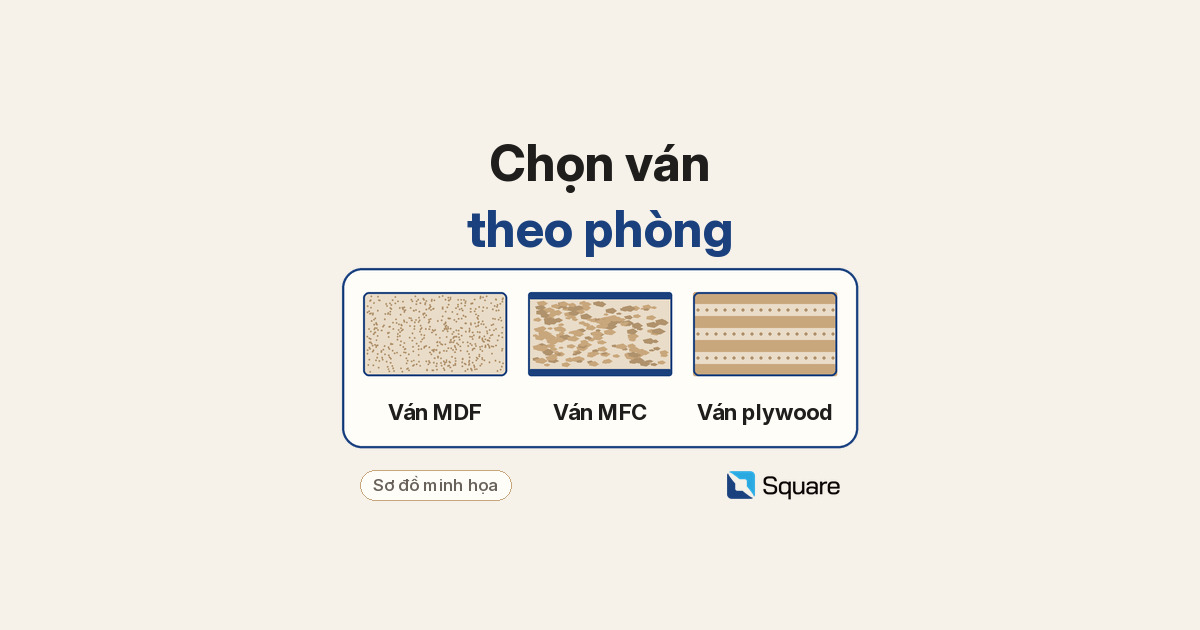
MDF là ván sợi ép mịn, mặt đều, gia công phào và sơn tốt, nhưng nặng và hút ẩm nhanh qua cạnh hoặc lỗ chưa bịt. MFC là ván dăm (hoặc tương đương) đã phủ melamine sẵn, phổ biến cho cốt tủ và tủ áo khu khô; cạnh thô yếu, phải dán cạnh. Plywood là ván nhiều lớp veneer bắt chéo, thường giữ vít tốt hơn và chịu ẩm ngắn hạn tốt hơn bản MDF hay MFC thông thường — vẫn phải bịt cạnh và chọn đúng cấp ghi trên hồ sơ, không phải vật liệu ngâm nước.
Đừng xếp chúng thành “xấu – vừa – tốt”. Hãy hỏi từng vị trí: việc này cần mặt sơn nhẵn, cần giữ vít, hay cần chịu nước bắn? Người chốt mã nên khớp ma trận RACI dự án nội thất.
Cốt tủ, cánh tủ và kệ — đừng dùng một loại cho mọi chi tiết
Cốt tủ (thùng) mang bản lề, ray và tải. Plywood thường được chọn khi cần giữ vít chắc hoặc gần nguồn nước; MFC hợp cốt khu khô nếu cấp, độ dày và cạnh được ghi rõ. MDF ít khi là lựa chọn đầu cho cốt dưới chậu vì cạnh và lỗ khoan ống dễ phồng.
Cánh sơn hoặc cánh phào thường dùng MDF vì mặt phẳng, ít lộ vân. Cánh phủ melamine có thể đi với cốt MFC cùng mã bề mặt. Kệ dài cần độ dày và cách gá đủ; đừng chỉ đổi tên ván mà không ghi khoảng cách gối kệ.
Gợi ý theo phòng — điểm xuất phát, không phải quy tắc cứng
Bếp: thùng dưới chậu và vị trí gần ống nước nên ưu tiên plywood hoặc cấp chống ẩm đã ghi mã, cạnh bịt kín; cánh sơn có thể là MDF nếu xa nguồn nhiệt và hơi trực tiếp. Chi tiết hệ khu ướt (cốt, bề mặt, cạnh, chân tủ, silicon) xem bài vật liệu chống ẩm bếp và WC — bài này không lặp lại toàn bộ hệ đó.
Phòng ngủ và phòng khách (tủ áo, kệ, vách khô): MFC phổ biến cho cốt và cánh phủ; MDF cho cánh sơn. WC, phòng giặt, tủ dưới chậu rửa: không dùng MDF hoặc MFC thường nếu cạnh và lõi chưa được chỉ định chống ẩm; hỏi cấp và cách bịt lỗ ống trước khi đặt hàng.
Khu ướt: chốt hệ, không chỉ đổi tên ván
Đổi “MFC” thành “plywood” trên báo giá chưa đủ nếu cạnh để trần, lỗ ống chưa bịt, hoặc mặt bằng còn ướt khi lắp. Hãy chốt cùng lúc: loại cốt, cấp (thường hay chống ẩm), bề mặt, cách dán cạnh, và chi tiết gần nước.
Mọi dòng vật tư nên có mã và vị trí — đối chiếu trước khi ký, xem kiểm báo giá từng dòng trước khi ký.
Những gì phải ghi trên báo giá và bản vẽ
Với từng hạng mục: loại ván (MDF / MFC / plywood), độ dày, cấp nếu có, mã bề mặt, loại cạnh, và phòng hay vị trí dùng. Thiếu các mục này, hai bên dễ hiểu “tủ bếp gỗ công nghiệp” thành hai vật liệu khác nhau.
Giữ cùng họ phiên bản giữa bản vẽ, bảng vật liệu và báo giá. Nếu đổi loại ván sau ngày chốt, cập nhật phụ lục trước khi cắt cốt.
Điều gì dễ nhầm — và checklist một trang
- Dùng một loại ván cho cả cốt, cánh và kệ, không phân việc.
- Chọn MDF hoặc MFC thường cho thùng dưới chậu, chưa bịt cạnh và lỗ.
- Báo giá chỉ ghi “gỗ công nghiệp” hoặc “plywood” mà không có mã, dày, cấp.
- Đổi tên ván khu ướt nhưng không chốt hệ cạnh–bề mặt–silicon.
- Đổi vật liệu sau khi chốt mà chưa cập nhật bản vẽ và phụ lục.
Trước khi đặt hàng, đọc lại năm dòng này trên một trang và khớp với mẫu cạnh thật.
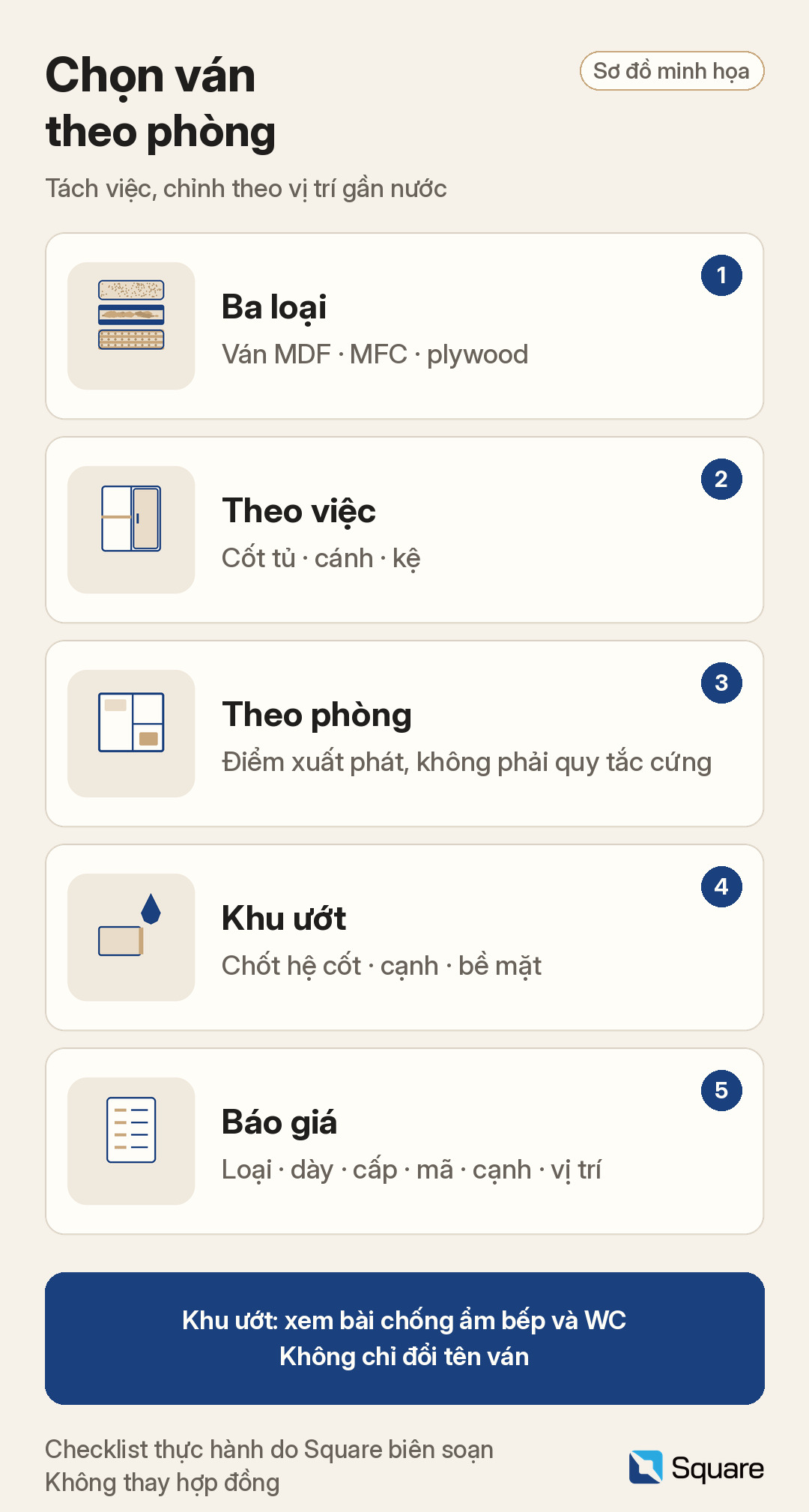
- Tách việc: cốt, cánh, kệ — loại ván cho từng việc.
- Gợi ý theo phòng, rồi chỉnh theo vị trí gần nước thật.
- Khu ướt: gửi về bài hệ chống ẩm; chốt cốt + cạnh + bề mặt.
- Mỗi dòng: loại, dày, cấp, mã bề mặt, cạnh, vị trí.
- Cùng phiên bản bản vẽ / vật liệu / báo giá trước khi cắt.
Câu hỏi thường gặp
Plywood có thay được toàn bộ hệ chống ẩm không?
Không tự động. Plywood vẫn cần cấp phù hợp, cạnh bịt và chi tiết gần nước. Hệ khu ướt nằm ở bài vật liệu chống ẩm bếp và WC.
MFC và MDF khác nhau chỗ nào, nhìn mặt phủ?
Không chỉ nhìn mặt. MDF là lõi sợi mịn; MFC là ván dăm (hoặc tương đương) đã phủ melamine. Hỏi lõi, không chỉ hỏi tên màu.
Có cần ghi TCVN trên báo giá không?
Chỉ ghi khi hồ sơ các bên đã chọn một tiêu chuẩn cụ thể và có bản kiểm tra kèm theo. Bài này không nêu mã tiêu chuẩn.
Square chia sẻ kiến thức về nhà ở và không gian sống. Khi cần thiết kế và thi công nội thất, bạn có thể liên hệ đội ngũ Square.
Cần hỗ trợ chốt loại ván theo phòng?
Liên hệ Square qua trang Liên hệ để trao đổi thiết kế – thi công nội thất và cách ghi loại ván, độ dày và vị trí trên hồ sơ trước khi đặt hàng.
Tham khảo thực hành, không thay hợp đồng, catalogue hãng hoặc tư vấn pháp lý. Không nêu số liệu thống kê, đơn giá hay mã TCVN; áp dụng theo hồ sơ và thỏa thuận các bên.
English version — sentence-aligned with the Vietnamese text above.
Choosing interior boards is not a question of “which type is best”. MDF, MFC (melamine-faced particleboard) and plywood are three different materials, suited to different jobs: a carcass, a painted door, a shelf, or a position near water. Using one type for every detail often fails at an edge, a screw hole, or a wet zone.
A practice checklist prepared by Square for apartment or townhouse design–build interiors. It is not a contract form or legal advice; the final call must match approved documents and party agreements. This article states no statistics, TCVN codes, or emission grades; codes and thicknesses must appear on the drawings and the quote. For kitchens and WCs, also read the core–edge–face system in choosing moisture-resistant materials for kitchens and WCs.
Three board types, three different jobs
MDF is a fine fibreboard with an even face, good for routed profiles and paint, but heavy, and it absorbs moisture quickly through an unsealed edge or hole. MFC is particleboard (or an equivalent) already faced with melamine, common for carcasses and wardrobes in dry rooms; a raw edge is weak and must be banded. Plywood is a cross-laminated veneer board; it often holds screws better and tolerates short moisture exposure better than standard MDF or MFC — edges must still be sealed, and the grade named on the documents still applies; it is not an immersion material.
Do not rank them as “poor – mid – best”. Ask for each location: does this job need a smooth painted face, screw holding, or resistance to splashes? Who locks the code should match the interior-project RACI matrix.
Carcasses, doors, and shelves — do not use one type for every detail
A carcass carries hinges, runners, and load. Plywood is often chosen when screw holding or a nearby water source matters; MFC suits a dry-room carcass if the grade, thickness, and edging are written clearly. MDF is rarely the first choice for a sink-base carcass, because edges and pipe holes swell easily.
Painted or profiled doors often use MDF because the face stays flat and shows little grain. A melamine door can match an MFC carcass in the same face code. A long shelf needs enough thickness and support; do not only change the board name without stating the shelf-support spacing.
A room-by-room starting point, not a hard rule
Kitchen: sink bases and positions near water pipes should prefer plywood or a moisture-resistant grade already given a code, with edges sealed; a painted door may be MDF if it sits away from direct heat and steam. Wet-zone system details (core, face, edge, plinth, silicone) are in the article on moisture-resistant materials for kitchens and WCs — this article does not repeat that whole system.
Bedrooms and living rooms (wardrobes, shelves, dry partitions): MFC is common for carcasses and faced doors; MDF is used for painted doors. WCs, laundry rooms, and vanity sink cabinets: do not use standard MDF or MFC if the edge and core have not been specified as moisture-resistant; ask for the grade and how pipe holes will be sealed before ordering.
Wet zones: lock a system, not only a board name
Changing “MFC” to “plywood” on a quote is not enough if edges are left raw, pipe holes are unsealed, or the site is still wet at install. Lock at the same time: the core type, the grade (standard or moisture-resistant), the face, the edging method, and the details near water.
Every material line should have a code and a location — cross-check before signing; see checking a quote line by line before signing.
What must appear on the quote and the drawings
For each item: the board type (MDF / MFC / plywood), thickness, grade if any, face code, edge type, and the room or position. Without these items, two parties can read “engineered-wood kitchen cabinets” as two different materials.
Keep the drawings, the material schedule, and the quote in the same revision family. If the board type changes after lock, update the appendix before the carcass is cut.
What is easy to mix up — and a one-page checklist
- Using one board type for the carcass, the doors, and the shelves, with no split of jobs.
- Choosing standard MDF or MFC for a sink-base box, with edges and holes unsealed.
- A quote that only says “engineered wood” or “plywood”, with no code, thickness, or grade.
- Renaming the wet-zone board without locking the edge–face–silicone system.
- Changing the material after lock without updating the drawings and the appendix.
Before ordering, reread these five lines on one page and match them to a real edge sample.
- Split the jobs: carcass, door, shelf — a board type for each job.
- Start from the room guide, then adjust for the real position near water.
- Wet zones: send readers to the moisture-resistant-system article; lock core + edge + face.
- Each line: type, thickness, grade, face code, edge, and location.
- The same revision of drawings / materials / quote before cutting.
FAQ
Does plywood replace the whole moisture-resistant system?
Not automatically. Plywood still needs a suitable grade, sealed edges, and wet-area details. The wet-zone system sits in the article on moisture-resistant materials for kitchens and WCs.
How do MFC and MDF differ, if you only see the face?
Do not judge by the face alone. MDF is a fine fibre core; MFC is particleboard (or an equivalent) already faced with melamine. Ask about the core, not only the colour name.
Must a TCVN code appear on the quote?
Only if the parties have already chosen a specific standard and have a test report to go with it. This article does not state standard codes.
Square shares knowledge about housing and living spaces. When you need interior design and construction, you can contact the Square team.
Need help locking board types by room?
Contact Square via the Contact page to discuss design–build interiors and how to write board type, thickness, and location on the documents before ordering.
Practice reference only; not a substitute for contracts, brand catalogues, or legal advice. No statistics, unit prices, or TCVN codes are stated; apply per documents and party agreements.