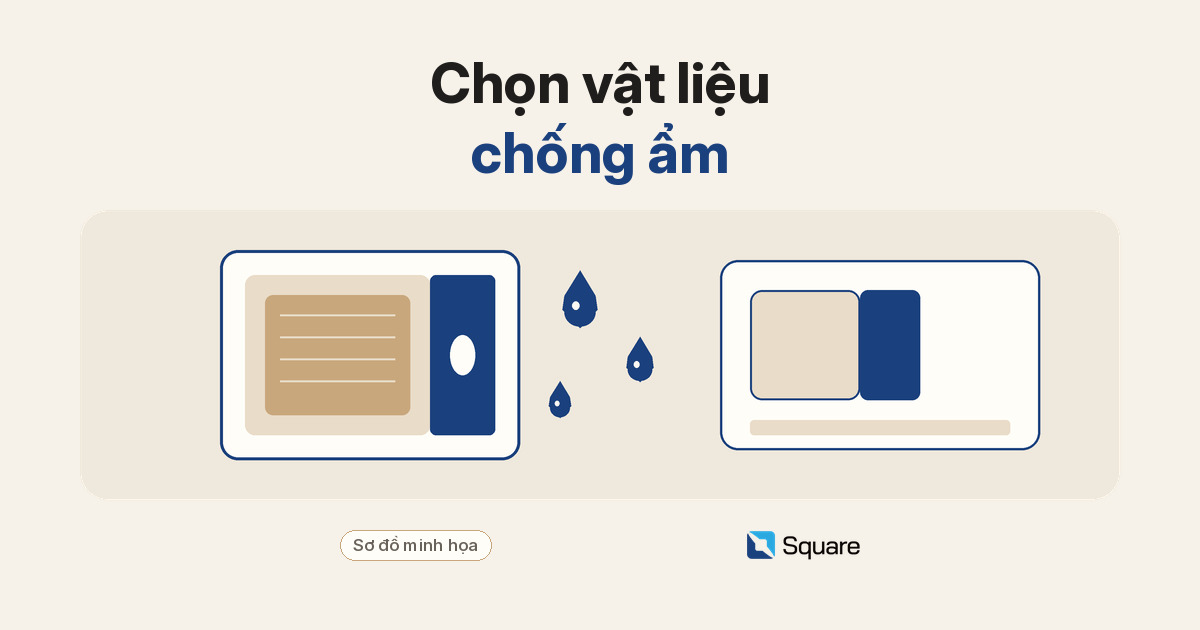
Bếp và nhà vệ sinh luôn ẩm, nóng và có nước bắn. Chọn vật liệu chịu ẩm đúng chỗ giúp tủ, vách và sàn ổn định lâu hơn; chọn sai dễ phồng cạnh, tách keo và nấm mốc sau vài mùa mưa.
Checklist thực hành do Square biên soạn khi chọn vật liệu cho khu ướt trong căn hộ hoặc nhà phố. Không phải tiêu chuẩn kỹ thuật hay tư vấn pháp lý; kết luận cuối phải khớp bản vẽ đã duyệt, mẫu đã chốt và hợp đồng. Khi cần soi từng dòng giá vật liệu, xem thêm kiểm báo giá nội thất từng dòng trước khi ký.
Khu ướt khác khu khô chỗ nào?
Khu khô (phòng ngủ, phòng khách) ít gặp nước đứng và hơi nước liên tục. Khu ướt gồm bếp, nhà vệ sinh, khu giặt và đôi khi ban công nối bếp. Ở đây cạnh tủ, chân tường và mặt dưới mặt đá thường tiếp xúc hơi ẩm hoặc nước nhỏ giọt.
Hỏi rõ từng vị trí: thùng tủ dưới chậu, cánh gần bếp nấu, vách sau bếp, sàn WC, khu vực máy nước nóng. Một loại tấm “chống ẩm” trên catalogue chưa đủ nếu cạnh tấm không được bịt kín và hiện trường vẫn ướt khi lắp.
MDF, HDF chống ẩm và gỗ công nghiệp: đọc đúng nhãn
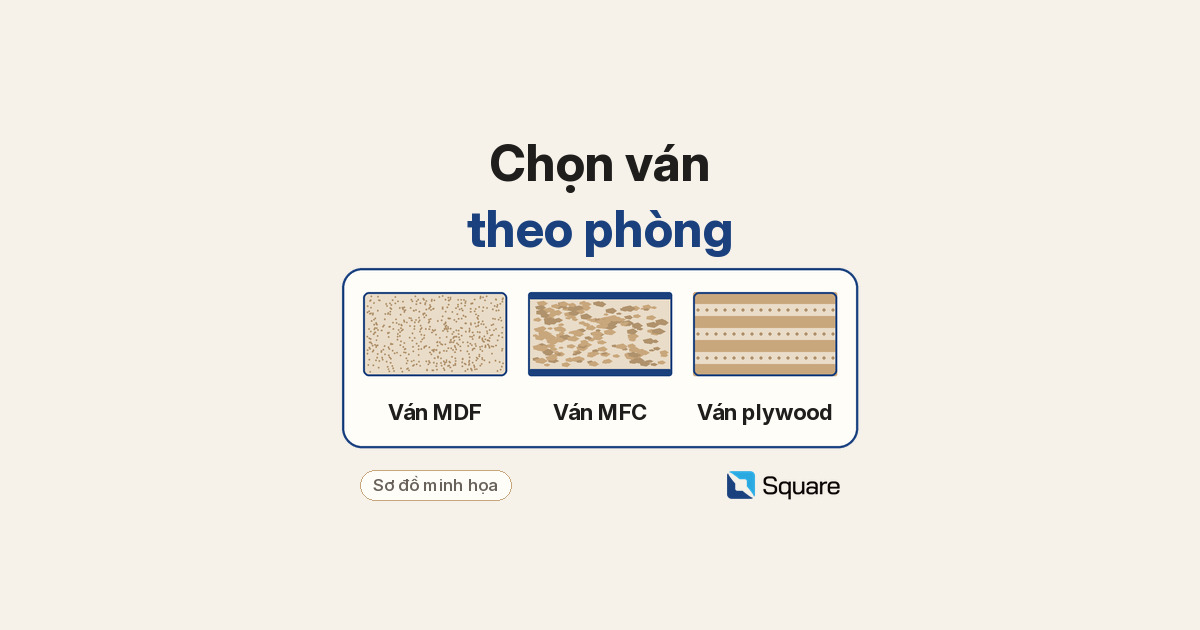
MDF và HDF là gỗ công nghiệp ép; bản thường hút ẩm nhanh nếu nước vào cạnh hoặc lỗ khoan. Bản “moisture resistant” hoặc “MR” thường thêm chất chống ẩm trong lõi và bề mặt ổn định hơn ở môi trường ẩm — nhưng không phải vật liệu ngâm nước lâu dài.
Khi nhận mẫu hoặc báo giá, hỏi:
- Mã sản phẩm và độ dày thực tế (không chỉ “18 mm tương đương”).
- Đây là bản chống ẩm lõi, phủ melamine/laminate, hay chỉ sơn bề mặt?
- Nhà sản xuất khuyến cáo dùng trong nhà, khu bán ướt, hay ngoài trời có mái?
- Cạnh tấm sau khi cắt có bắt buộc dán cạnh PVC/ABS không, và ai làm việc đó?
Đừng dựa vào màu xanh của lõi như bằng chứng duy nhất: màu chỉ là nhận diện thị trường; hãy giữ tờ thông số hoặc catalogue trang có mã.
Laminate, acrylic và bề mặt trang trí
Laminate (HPL/LPL) phủ lên cốt gỗ tạo mặt chịu trầy và dễ lau. Acrylic hoặc bề mặt bóng cao cấp thường dùng cho cánh tủ; vẻ đẹp cao nhưng vết nước cứng và vết tay dễ lộ nếu không bảo dưỡng đúng cách.
Với khu bếp gần bếp nấu, hỏi nhiệt độ làm việc khuyến cáo của bề mặt, khoảng cách tới bếp gas/bếp từ, và có cần tấm chắn nhiệt cục bộ không. Với WC, ưu tiên bề mặt dễ lau, ít khe hở ngang nơi nước đọng.
Bề mặt đẹp không cứu được cốt gỗ nếu nước vào từ cạnh hoặc lỗ phụ kiện. Luôn đọc cặp “cốt + bề mặt + cạnh” như một hệ, không chọn từng phần rời.
Bịt cạnh, keo và chi tiết chống thấm cục bộ
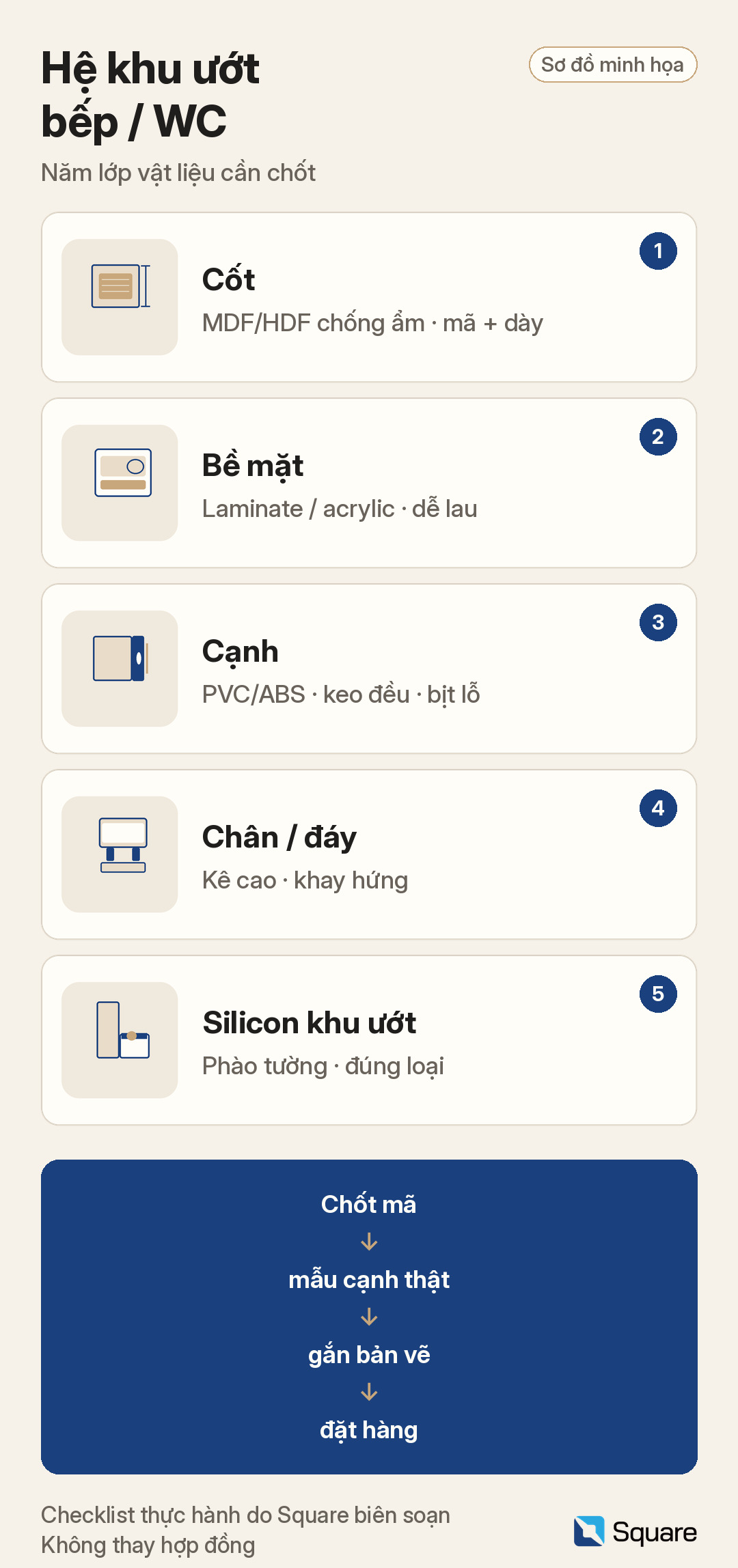
Cạnh cắt là điểm yếu nhất của gỗ công nghiệp. Dải cạnh PVC/ABS đúng bề dày, keo dán đều và cắt tỉa sát giúp chậm hút ẩm. Hỏi nhà thầu:
- Loại cạnh (PVC, ABS, melamine), bề dày, và có bo cong hay chỉ cạnh thẳng.
- Lỗ khoan bản lề, ổ khóa, ống nước có được xử lý keo bịt không.
- Chân tủ có kê cao / có chân điều chỉnh và khoảng thoát nước sàn không.
- Mặt đá hoặc mặt bàn có phào chắn nước phía tường và silicon đúng loại khu ướt không.
Với tủ dưới chậu, yêu cầu khay hứng nhỏ hoặc tấm lót đáy dễ thay; đó là chi tiết rẻ hơn thay cả thùng khi rò rỉ.
Câu hỏi nên gửi trước khi chốt mẫu
- Vị trí lắp thuộc khu khô, bán ướt hay ướt thường xuyên?
- Mã cốt, mã bề mặt, mã cạnh đã ghi trên báo giá và bản vẽ chưa?
- Ai chịu trách nhiệm cắt, dán cạnh và xử lý lỗ tại xưởng / tại công trình?
- Điều kiện bảo hành khi phồng cạnh do nước — lỗi vật liệu hay lỗi lắp?
- Có mẫu cắt cạnh thật để xem lõi và đường keo trước khi sản xuất hàng loạt không?
Ghi câu trả lời theo số câu trên cùng file; gắn với phiên bản bản vẽ. Vai trò ai duyệt thay mã nên khớp ma trận RACI dự án nội thất.
Dấu hiệu cần dừng và làm rõ
- Báo giá chỉ ghi “gỗ chống ẩm” không có mã.
- Cánh acrylic/laminate đắt nhưng thùng dùng cốt thường ở tủ dưới chậu.
- Không nêu hạng mục dán cạnh hoặc ghi “đã gồm” mà không mô tả.
- Lắp sát sàn ướt không có chân kê hoặc không có phương án thoát nước.
- Đổi mã “tương đương” khi chưa có tiêu chí dày, lõi, bề mặt và bảo hành.
Trước nghiệm thu, mở cánh tủ dưới chậu, nhìn cạnh và đáy — xem thêm checklist nghiệm thu nội thất căn hộ.
Checklist ngắn trước khi đặt hàng:
- Mỗi vị trí khu ướt đã gắn mã cốt + bề mặt + cạnh.
- Mẫu cạnh thật đã duyệt; ảnh hoặc biên bản giữ cùng phiên bản.
- Chi tiết chân tủ, khay hứng, silicon khu ướt đã có trên bản vẽ hoặc phụ lục.
- Điều kiện bảo hành phồng/tách cạnh đã viết rõ phạm vi.
- Báo giá không còn dòng “tương đương” mơ hồ cho khu ướt.
Câu hỏi thường gặp
Gỗ chống ẩm có ngâm nước được không?
Không nên hiểu là vật liệu ngâm lâu. Bản chống ẩm chịu môi trường ẩm và nước bắn tốt hơn bản thường nếu cạnh và lỗ được xử lý; nước đứng lâu vẫn làm hỏng.
Nên ưu tiên laminate hay acrylic cho cánh bếp?
Tùy thẩm mỹ và thói quen lau. Quan trọng hơn là cốt và cạnh phù hợp khu ẩm; bề mặt chỉ là lớp ngoài.
Có bắt buộc dùng một hãng cụ thể không?
Bài này không chỉ định thương hiệu. Hãy chốt mã và thông số trên hồ sơ; đổi mã phải có người duyệt bằng văn bản.
Square chia sẻ kiến thức về nhà ở và không gian sống. Khi cần thiết kế và thi công nội thất, bạn có thể liên hệ đội ngũ Square.
Cần hỗ trợ chọn vật liệu khu ướt?
Liên hệ Square qua trang Liên hệ để trao đổi thiết kế – thi công nội thất và cách chốt vật liệu trước khi sản xuất.
Tham khảo thực hành, không thay hợp đồng, chỉ dẫn kỹ thuật bắt buộc hoặc tư vấn pháp lý. Không nêu số liệu thống kê hay mã TCVN cụ thể; áp dụng theo hồ sơ và thỏa thuận các bên.
English version — sentence-aligned with the Vietnamese text above.
Kitchens and bathrooms stay damp, warm, and splash-prone. Choosing moisture-ready materials in the right places helps cabinets, walls, and floors stay stable longer; the wrong choice often means swollen edges, failed glue, and mould after a few rainy seasons.
A practice checklist prepared by Square for wet-area materials in apartments or townhouses. It is not a technical standard or legal advice; the final call must match approved drawings, locked samples, and the contract. When you need to read material lines one by one, see also checking an interior quote line by line before signing.
How do wet areas differ from dry ones?
Dry areas (bedrooms, living rooms) rarely see standing water or continuous vapour. Wet areas include the kitchen, bathroom, laundry, and sometimes a balcony tied to the kitchen. Here cabinet edges, skirting lines, and the underside of worktops often meet moisture or drips.
Ask by location: the sink base, doors near the cooktop, the backsplash zone, the WC floor, the water-heater niche. A catalogue “moisture-resistant” sheet is not enough if edges are unsealed and the site is still wet during install.
Moisture-resistant MDF/HDF and engineered boards: read the label
MDF and HDF are engineered wood; standard grades absorb moisture quickly once water reaches edges or drill holes. “Moisture resistant” or “MR” grades usually add moisture resistance in the core and a more stable face in humid rooms — yet they are not long-term immersion materials.
When you receive a sample or quote, ask:
- The product code and actual thickness (not only “18 mm equivalent”).
- Is resistance built into the core, a melamine/laminate face, or only a surface paint?
- Does the maker rate it for indoor, semi-wet, or covered outdoor use?
- After cutting, must edges take PVC/ABS edging, and who applies it?
Do not treat a green core colour as sole proof: colour is market coding; keep the datasheet or catalogue page with the code.
Laminate, acrylic, and decorative faces
Laminate (HPL/LPL) on a wood core gives a scrub-friendly, scratch-tougher face. Acrylic or high-gloss faces are common on doors; they look premium but show hard-water marks and fingerprints if care is poor.
Near cooktops, ask the face’s recommended working temperature, clearance to gas or induction, and whether a local heat shield is needed. In WCs, prefer easy-clean faces with fewer horizontal joints where water sits.
A beautiful face will not save a core if water enters at edges or hardware holes. Always read “core + face + edge” as one system, not as separate picks.
Edge banding, adhesives, and local wet detailing
Cut edges are the weakest point of engineered boards. Correct-thickness PVC/ABS edging, even glue, and a clean trim slow moisture uptake. Ask the contractor:
- Edge type (PVC, ABS, melamine), thickness, and whether edges are radiused or square.
- Whether hinge holes, lock holes, and pipe penetrations are sealed.
- Whether cabinet bases are raised / have adjustable feet and a clear floor drainage path.
- Whether the worktop has a wall upstand and a wet-area-rated silicone.
For sink bases, ask for a small drip tray or a replaceable base liner; that detail costs less than replacing a whole carcass after a leak.
Questions to send before locking samples
- Is the install location dry, semi-wet, or frequently wet?
- Are core, face, and edge codes already on the quote and drawings?
- Who cuts, edges, and seals holes in the shop / on site?
- What does the warranty say when edges swell from water — material fault or install fault?
- Is there a real edged sample to inspect the core and glue line before mass production?
Record answers by question number on the same file; tie them to the drawing revision. Who may approve a code change should match the interior-project RACI matrix.
Signals to pause and clarify
- The quote only says “moisture-resistant wood” with no code.
- Doors are acrylic/laminate while sink carcasses use a standard core.
- Edging is missing as a line or marked “included” with no description.
- Units sit on a wet floor with no feet or drainage plan.
- “Equivalent” substitutions without thickness, core, face, and warranty criteria.
Before handover, open the sink doors and look at edges and the base — see also the apartment interior handover checklist.
Short checklist before ordering:
- Every wet location has core + face + edge codes.
- A real edged sample is approved; photos or minutes sit with the same revision.
- Feet, drip trays, and wet-area silicone appear on drawings or an appendix.
- Warranty scope for swell/delamination is written.
- The quote has no vague “equivalent” lines for wet zones.
FAQ
Can moisture-resistant boards sit in standing water?
Do not treat them as immersion materials. MR grades handle humid rooms and splash better than standard grades when edges and holes are sealed; prolonged standing water still damages them.
Should kitchen doors prefer laminate or acrylic?
It depends on look and cleaning habits. More important is a core and edge suited to humidity; the face is only the outer layer.
Must you use one named brand?
This article does not name brands. Lock codes and specs on the documents; any code change needs written approval from the named approver.
Square shares knowledge about housing and living spaces. When you need interior design and construction, you can contact the Square team.
Need help choosing wet-area materials?
Contact Square via the Contact page to discuss design–build interiors and locking materials before production.
Practice reference only; not a substitute for contracts, mandatory technical instructions, or legal advice. No statistics or specific TCVN codes are stated; apply per documents and party agreements.